Scarring Alopecia

Scarring alopecia creates inflammation, which damages hair follicles, and the resulting damage leads to permanent hair loss. If an individual has this condition, their hair follicles are destroyed and replaced with scar tissue. In most cases, the condition is only treatable to a certain degree; however, an early start of the treatment modalities ensures better results.

How Is Scarring Alopecia Diagnosed?

Performing a clinical examination with trichoscopy is necessary in all cases of scarring alopecia. Biopsy is also often necessary, especially when the diagnosis is not clear. It also helps to assess the severity of inflammation present in the sample and the amount of scarring to guide the treatment. The procedure is relatively quick, taking about 20 to 25 minutes total.

Some additional tests needed to diagnose scarring alopecia include blood work and the examination of other skin parts and nails. An examination of other parts of the body is required to diagnose scarring alopecia because the condition can lead to inflammation of hair follicles on various segments of a person’s skin.

What Are the Main Subtypes of Scarring Alopecia?

The main subtypes of scarring alopecia are:

  • Frontal fibrosing alopecia (FFA)
  • Folliculitis decalvans (FD)
  • Lichen planopilaris (LPP)
  • Central Centrifugal Cicatricial Alopecia (CCCA)
  • Acne keloidalis
  • Discoid lupus erythematosus (DLE)
  • Dissecting folliculitis of the scalp

Where Science Meets Elegance

Your skin tells your story — let it reflect the very best version of you. Our team provides expert, personalized care designed to help you look and feel radiant at every age.

What Are the Main Subtypes of Scarring Alopecia?

Frontal Fibrosing Alopecia

FFA is a type of scarring alopecia that progresses gradually, affecting the edges of a person’s head. Those with FFA experience hair loss in the areas near their forehead. These areas also become scarred. People with FFA may also witness the loss of their eyebrows and eyelashes. The age of onset for this condition ranges from 19 to 65. The cause of FFA is not known. However, many speculate that it arises due to autoimmune responses and hormonal changes. Practitioners often use medications like finasteride, dutasteride, and hydroxychloroquine as well as laser therapy and steroid injections to treat FFA.

Folliculitis Decalvans

FD is a kind of scarring alopecia that destroys hair follicles, causing permanent hair loss. This condition causes a patch of alopecia to form and expand on an individual’s head. Peripheral pustules also appear on the scalp. Many people with FD experience a great deal of pain in the regions where it manifests. Doctors and scientists have yet to determine the cause of FD, but many of them believe that it is an abnormal reaction to certain bacteria. This is why many dermatologists use antibiotic therapy to treat this condition.

Lichen Planopilaris

LPP is a scarring alopecia that affects the skin and mucous membranes. LPP causes inflammation, which leads to hair loss and scaly skin. A person with LPP typically has bald patches that are red and have small bumps on them. These patches can be painful, producing burning and itching sensations and a great deal of discomfort for the individual affected. LPP can result in scarring, which can then result in permanent hair loss. Many believe that LPP is an autoimmune condition. Nonetheless, the exact cause of LPP is unknown.

Central Centrifugal Cicatricial Alopecia

CCCA is a form of scarring alopecia that starts in the central crown region of a person’s head and gets bigger over time. CCCA occurs mainly in Afro-American females who are over 30 years of age. Those with CCCA often suffer from tenderness, flaky skin, and pain in the affected region of their scalp. The exact reason for CCCA is not known, but currently, a theory of an early damage of the hair follicle (premature follicle desquamation) is the most accepted one. The hair loss in CCCA is usually asymptomatic, but in some cases patients may complain of itching or burning..

Acne Keloidalis

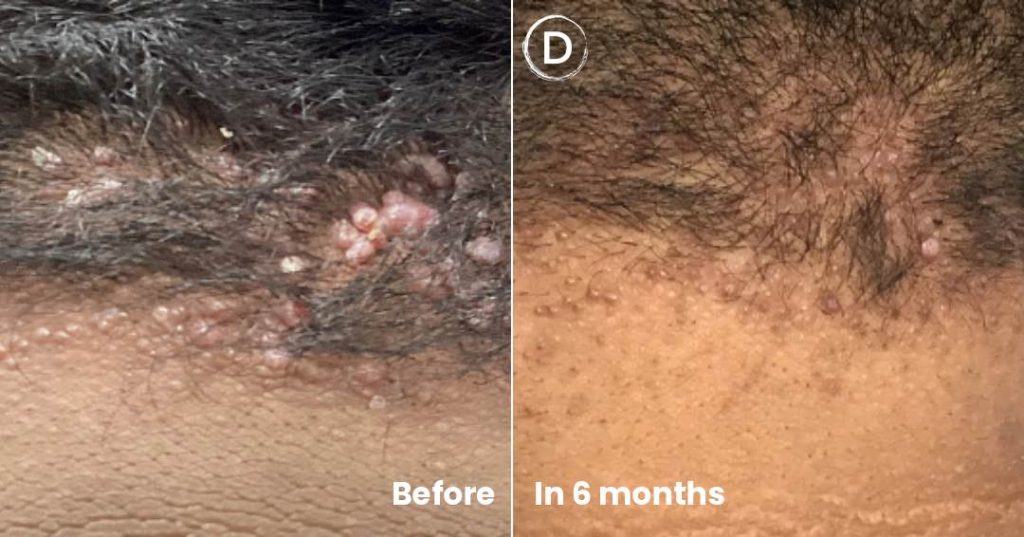
Acne keloidalis is more common in Afro American patients and presents with firm bumps on the posterior scalp. When they progress, they may leave areas of scarring and hair loss.

Discoid Lupus Erythematosus

Discoid lupus erythematosus (DLE) may happen exclusively on the scalp or may have other presentations. The condition is more common in African Americans and Latino patients. It may also happen in patients with systemic lupus erythematosus. Erythema and scaling may be seen in the early lesions, followed by hyperpigmentation and visible scarring and atrophy in the late stages of the DLE. Burning, tenderness, and sometimes pain are common.

Dissecting Folliculitis of the Scalp

In dissecting folliculitis of the scalp large purulent nodules appear on the scalp. They gradually form soft boggy areas with purulent discharge and may lead to hair loss. The condition is notoriously difficult to treat.

Before & Afters

What Are the Treatment Methods for Scarring Alopecia?
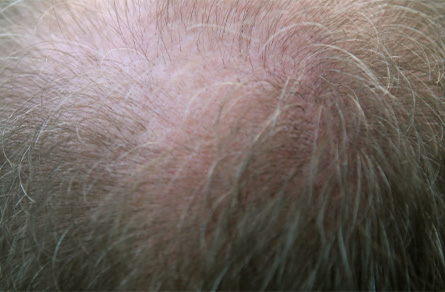
The treatment methods for scarring alopecia include steroid injections, topical steroid medications, oral medications, and laser therapy.

Steroid Injections

During a steroid injection procedure, a dermatologist will inject a corticosteroid solution into a bald patch. This solution stimulates hair growth. Steroid injection procedures typically occur every 4-6 weeks. It may take up to 8 weeks for a patient to witness hair growth. Steroid injections can also reduce inflammation for those with scarring alopecia. These injections are ideal for those who experience hair loss on their brow area and need regrowth.

Oral Medications

There are several kinds of oral medications used to treat scarring alopecia. Finasteride and dutasteride are oral medications that can prevent hair loss from worsening in FFA. These medications should not be used in females before menopause. Hydroxychloroquine is an antimalarial drug that can potentially be used for scarring alopecias, especially in lupus erythematosus and LPP. In other instances, oral antibiotics or anti-inflammatory medications are given depending on the diagnosis.

Topical Steroid Medications

A steroid cream or ointment can prevent patches from growing larger and diminish the inflammation.

Where Confidence Begins.

Reveal the beauty of healthy skin with treatments tailored to you. Dr. Kazlouskaya & her team combines medical expertise with artistry to deliver natural, timeless results.